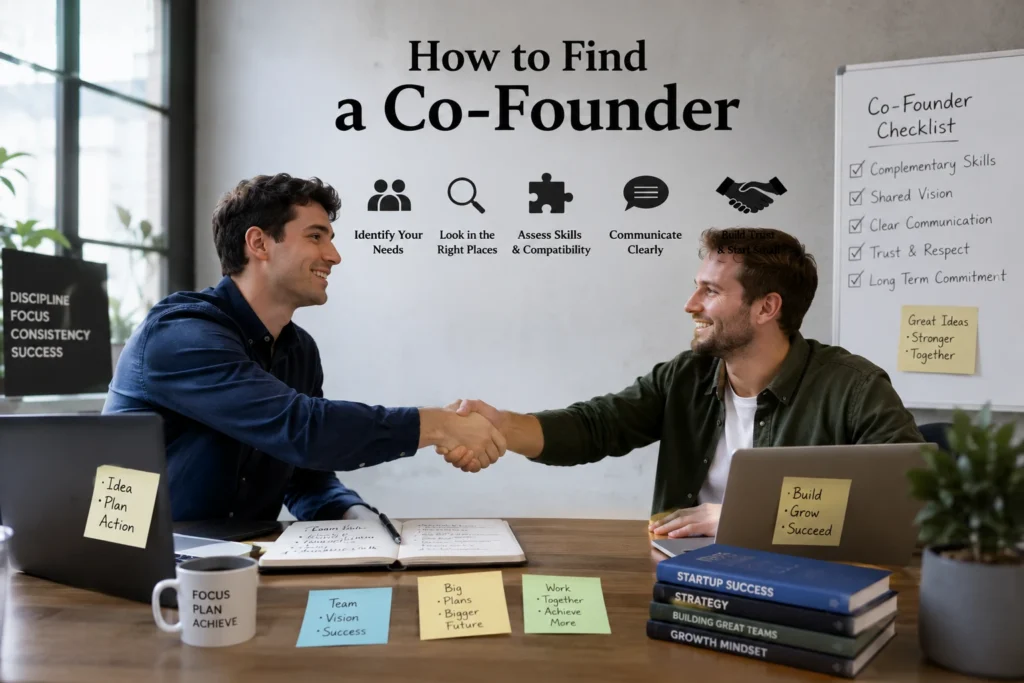
How to Find a Co-Founder or Co-Founder Support
Most first-time founders spend months messaging strangers on LinkedIn or waiting for the “right person” to show up at a networking event and still end up going solo, even though startups with co-founders are roughly 3x more likely to succeed.
The fix isn’t more patience. It’s searching in the right places. Serious founders already gather in curated communities, structured matching platforms, and their own extended professional networks, not in generic Facebook groups. Once you know where to look and how to evaluate fit properly, the search gets a lot faster. And if the right person still doesn’t show up in time, co-founder support options exist so you’re not stuck choosing between a bad match and going it alone.
This guide covers exactly how to find a co-founder the right way, plus what to do if you decide not to force it.
Why Finding a Co-Founder Feels So Hard
It’s not that co-founders don’t exist. It’s that most founders look in places with low signal, like random LinkedIn DMs, generic Facebook groups, or a single college friend who happens to be free.
The data explains why this search deserves more care than most founders give it:
- Team misalignment contributes to roughly 23% of startup failures, and in some cohorts, co-founder conflict is tied to as much as 65% of failures.
- Nearly 3 in 10 multi-founder startups lose at least one co-founder within the first five years, rising to about 4 in 10 by year eight.
- Despite the risk, startups with co-founders still outperform solo-founded ones by a wide margin in long-term success rates.
In other words, figuring out how to find a co-founder is hard, but finding the wrong one is worse than staying solo. That’s exactly why speed alone shouldn’t drive this search the right channel matters as much as the right person, and rushing past evaluation to “just have a co-founder” tends to backfire within the first two years.
The Fastest Way to Find a Co-Founder
If you need a quick answer before reading the full breakdown, the fastest way to find a co-founder is to join a curated, active founder community rather than posting in generic groups and waiting.
Curated communities filter for people already building, not just browsing, which cuts down the noise dramatically compared to open platforms. Members show up already committed to something, so conversations move from “what are you working on” to real collaboration much faster than on a cold platform. This is exactly why building a founder network from scratch is usually the first real step in learning how to find a co-founder, even before you touch a dedicated matching platform.
7 Proven Places to Find a Co-Founder
Once you understand the general approach, here’s a detailed breakdown of exactly how to find a co-founder across the channels that actually produce results not just theoretical advice.
1. Curated Founder Communities
WhatsApp and Slack-based founder communities work well because members are already vetted for seriousness; you’re not messaging strangers cold. This is often the single best answer to how to find a co-founder for founders who want warm introductions over cold outreach. If you’re deciding which one to join, it helps to know how to find the right WhatsApp community for your startup journey before committing your time to one.
2. Co-Founder Matching Platforms
Platforms built specifically for this purpose remove a lot of the guesswork, and they’re often the first thing people search for when researching how to find a co-founder online:
- Y Combinator’s Co-Founder Matching — free, structured, and widely used by both YC and non-YC founders looking for technical or business co-founders. Profiles include prior work history, which adds a useful trust signal.
- Wellfound (formerly AngelList) — useful if you’re also planning to hire early team members alongside a co-founder search, since it doubles as a hiring platform.
- CoFoundersLab — one of the older, dedicated matching platforms with filters by skill set, industry, and location, useful if you want to narrow the search geographically.
3. LinkedIn — Targeted, Not Generic
A generic “looking for co-founder” post rarely works. What performs better: posting specific problem statements you’re solving and the exact skill gap you have, then engaging directly with people who comment, not just waiting for DMs. Founders searching for how to find a co-founder on LinkedIn specifically often get better results by commenting thoughtfully on other founders’ posts first, building visibility before ever mentioning they’re looking.
4. College and Alumni Networks
If you’re building something technical, campus incubators and alumni founder groups remain a strong source when figuring out how to find a co-founder, since there’s already a shared trust baseline. This ties closely into growing your startup network beyond just your immediate friend circle.
5. Hackathons and Startup Events
Hackathons compress the “working together” test into 24–48 hours, which is often more revealing about compatibility than weeks of conversation. Several founders who later credit hackathons with solving how to find a co-founder say the pressure-tested trial run mattered more than any resume.
6. Build-in-Public on X (Twitter)
Founders who post progress updates publicly often attract co-founder interest organically; people reach out because they’ve already seen your thinking and work ethic, which skips a lot of the early trust-building.
7. Your Existing Professional Network
The most overlooked channel when people ask how to find a co-founder: former colleagues, teammates from past jobs, or people you’ve already worked with under pressure. You already have real data on how they operate, which generic platforms can’t replicate. This is a core part of building powerful connections online and offline simultaneously; most strong co-founder matches come from combining channels, not relying on just one.
What Is a Technical Co-Founder?
If you don’t come from an engineering background, a technical co-founder is often the specific type of co-founder you should prioritize when figuring out how to find a co-founder that actually fills your biggest gap. They own product architecture and development, help you ship faster, and their presence alone makes it easier to hire the right engineers later. For product-heavy startups, having one on the founding team is frequently treated as a signal of credibility by early investors it shows the technical risk is covered from day one.
How to Evaluate a Potential Co-Founder
Knowing how to find a co-founder gets you halfway there; evaluating fit properly is what prevents you from becoming part of the failure statistics mentioned earlier.
- Test with a small project first.
Work together on something small and time-boxed before committing to equity or incorporation. A few weeks of building something real reveals working style and conflict-handling far better than conversation alone. - Discuss vesting early, not after conflict starts.
A standard four-year vesting schedule with a one-year cliff protects both sides if someone leaves early. - Align on commitment level explicitly.
Full-time versus part-time mismatches are one of the most common, and most preventable, causes of co-founder breakups. - Talk about equity splits directly, even though it’s uncomfortable. Avoiding the conversation early almost always makes it worse later.
- Check for complementary — not identical — skills.
Two people with the same strengths often duplicate effort rather than cover gaps. - Do reference checks like you would for a senior hire.
Talk to former colleagues or co-workers about how the person handles pressure, disagreement, and ambiguity, not just their technical output.
A few specific questions worth asking during due diligence:
- What’s the most stressful situation you’ve navigated professionally, and how did you handle it?
- How do you typically approach disagreements with a peer, not a subordinate?
- Would your former colleagues describe you as someone who follows through?
Getting this evaluation right matters more than speed; it’s a direct extension of understanding the benefits of founder networking in the first place: the goal was never just “find a person,” it was finding the right one.
Determining Leadership Roles Early On
Once you’ve found a co-founder, deciding who holds which title matters more than it seems in the early days; investors and early hires read into it, even when both of you are doing overlapping work.
- CEO — usually the person best suited to lead investor conversations and set overall strategic direction; the external face of the company.
- CTO — the technical co-founder typically takes this role, owning product architecture, engineering hires, and the technical roadmap.
- COO — focuses on day-to-day operations, hiring processes, finance workflows, and turning strategic goals into an operating plan.
If both co-founders want the CEO title, that’s often an early signal of a values mismatch worth resolving before it becomes a bigger conflict later, not something to paper over for the sake of moving fast.
How to Split Equity With a Co-Founder
Once you’ve figured out how to find a co-founder, the next real decision is about equity. A 50/50 split feels fair on paper, but it isn’t automatic. Contribution, risk taken, and time invested before the split all matter, and the data backs this up: according to Carta’s own equity data, only about one-third of co-founders actually end up splitting equity equally.
A workable approach:
- List out each founder’s contribution so far: idea origination, capital put in, time invested, and skills brought.
- Agree on a split that honestly reflects those contributions, even if it isn’t a clean 50/50.
- Attach a standard vesting schedule (commonly four years with a one-year cliff) so equity is earned over time, not granted upfront regardless of what happens next.
Co-Founder Support: What to Do If You Don’t Find One
Not finding a co-founder in your target timeline isn’t a failure; forcing a bad match usually is. If the search stalls, a few co-founder support alternatives work well:
- Fractional or advisory co-founders — someone with relevant expertise who takes a smaller equity stake for part-time involvement, rather than a full co-founder commitment. This works especially well for technical gaps when you can’t yet afford or justify a full-time hire.
- Strong early hires instead of a co-founder — solo founders who build a capable early team can still perform well; recent data shows solo-founded companies make up roughly 30–40% of venture-backed startups and a comparable share of successful exits, so going solo is far from a disqualifying factor.
- Advisors and mentors from your network — filling specific skill gaps (technical, financial, legal) without giving up equity meant for a true co-founder. A good advisor relationship can also evolve into a co-founder relationship later, once trust is established.
The key distinction with any co-founder support option is that it fills gaps without the long-term commitment and equity implications of a full partnership useful when you need help now but haven’t found the right long-term match yet. Founders who treat these as permanent solutions rather than bridges tend to under-invest in the ongoing co-founder search, so it’s worth revisiting the question periodically rather than closing it off entirely.
Quick Comparison of Co-Founder Channels
Here’s a fast reference for how to find a co-founder depending on your speed and trust priorities:
Channel | Best For | Speed |
Curated founder communities | Vetted, serious founders | Fast |
Co-founder matching platforms | Structured, skill-based search | Medium |
College/alumni networks | Technical co-founders, shared trust | Medium |
Hackathons/events | Testing real working compatibility | Fast (but limited pool) |
Existing professional network | Highest trust, proven track record | Fastest, if available |
Conclusion
Knowing how to find a co-founder comes down to searching in higher-signal places: curated communities, matching platforms, and your existing network rather than posting generically and hoping. Evaluate fit properly before committing, and if the right person doesn’t appear in time, use co-founder support options instead of forcing a mismatch just to avoid going solo.
The founders who get this right treat the search itself as a skill worth practicing, showing up consistently in the right channels, evaluating honestly, and staying patient enough to avoid the 65% failure trap tied to co-founder conflict.
Want to meet serious, active founders instead of searching cold? Join The Founders Circle, a curated founder community where co-founder searches actually go somewhere.
FAQs
How to find a co-founder quickly without wasting months?
Join a curated founder community first vetted, active founders respond faster than cold platform searches, and consistent effort in the right channel typically produces serious candidates within a few weeks to a couple of months.
Is it better to have a co-founder or stay solo?
Data shows co-founded startups succeed at notably higher rates than solo ones on average, but a forced or misaligned co-founder relationship often perform worse than staying solo fit matters more than simply having a partner.
What is co-founder support if I can't find a co-founder?
It refers to alternatives like fractional co-founders, advisors, or strong early hires who fill specific skill gaps without a full equity partnership.
Where do most successful co-founder matches actually come from?
Most people learning how to find a co-founder discover that combining channels works best an existing professional connection reinforced through a founder community or shared project, rather than a single cold platform match.
How much equity should a co-founder get?
There’s no fixed rule, but splits should reflect actual contribution and commitment level, paired with a standard vesting schedule so equity is earned over time rather than granted upfront.
What are the biggest red flags when evaluating a potential co-founder?
Vague commitment levels, avoidance of equity conversations, and no track record of working together under real pressure are the most common warning signs.